
Fossilien & Inclusions
How Fossilien and Insekten Become Preserved in Bernstein
A detailed step-by-step guide to resin entrapment, preservation, burial, polymerization, inclusions, distortion and scientific identification.
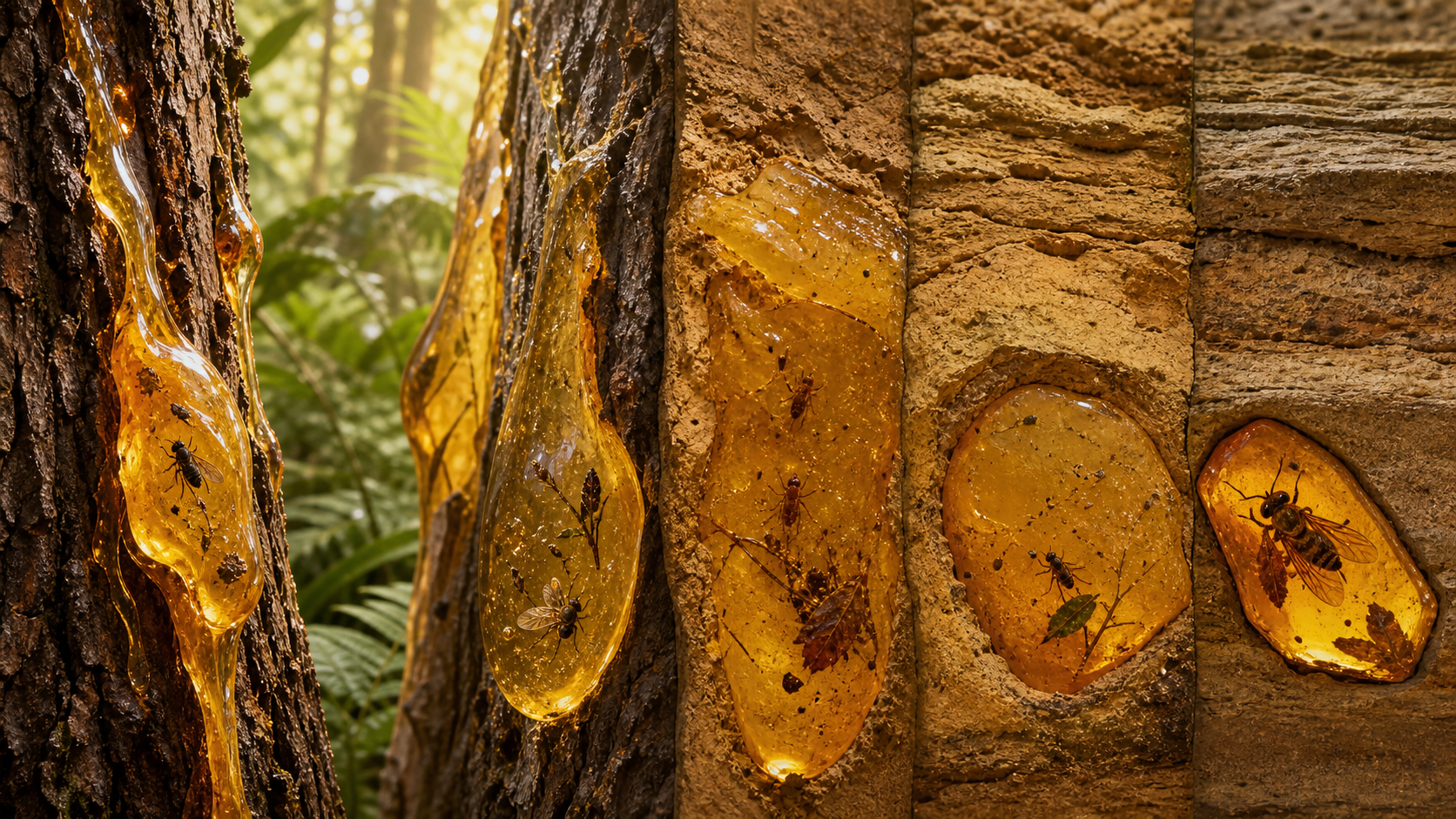
Herkunftal editorial illustration created for this guide. It is not a laboratory specimen, archaeological photograph or reconstruction.
1. A tree releases resin
Resin is a sticky organic secretion produced by certain plants, often after injury or attack. It is not the same as sap. Resin can flow across bark, pool near a trunk or drip into surrounding litter. Its chemistry discourages some organisms and helps seal damaged tissue.
2. An organism or fragment is trapped
Small insects, mites, spiders, pollen, fungal material, feathers and plant fragments can contact fresh resin. Tiny organisms are more likely to be engulfed than large ones. Struggle may distort legs or wings, create flow lines or add debris. Multiple resin flows can surround the inclusion and improve sealing.
3. Early preservation begins
Sticky resin limits movement and may reduce exposure to oxygen, scavengers and microbes. Chemical compounds in resin can slow decomposition, but preservation is selective. Soft tissues often shrink or collapse, gases may form bubbles, and an inclusion can become coated or obscured.
4. Burial and maturation
Resin must survive transport, weathering and burial. Over long periods, volatile components are lost and molecules cross-link and polymerize. Heat, pressure, oxygen exposure, sediment chemistry and geological history influence whether resin remains immature, becomes copal-like material or matures into amber.
5. Discovery, preparation and study
Mined amber may be covered by host sediment or weathered crust. Cutting and polishing reveal internal features but can also remove evidence or place an inclusion dangerously close to the surface. Researchers examine body form, wings, antennae, legs, mouthparts and other visible characters. A single photograph often supports only an order- or family-level identification.
Limits of identification
Bernstein can magnify, refract and distort. Cracks, plant fibers and bubbles may resemble biological structures. Confident species-level identifications require diagnostic features, suitable viewing angles and specialist comparison. Sales descriptions should separate what is visible from what is inferred.
Sources and further reading
Explore exact-item pieces
Every available piece is individually photographed, so the item shown is the item you receive.
Shop related piecesMore journal articles