
Amber Guide
Dominican Amber vs. Baltic Amber: Origin, Age, Color and Inclusions
Compare Dominican and Baltic amber by geological age, botanical source, chemistry, transparency, fluorescence, inclusions and identification limits.
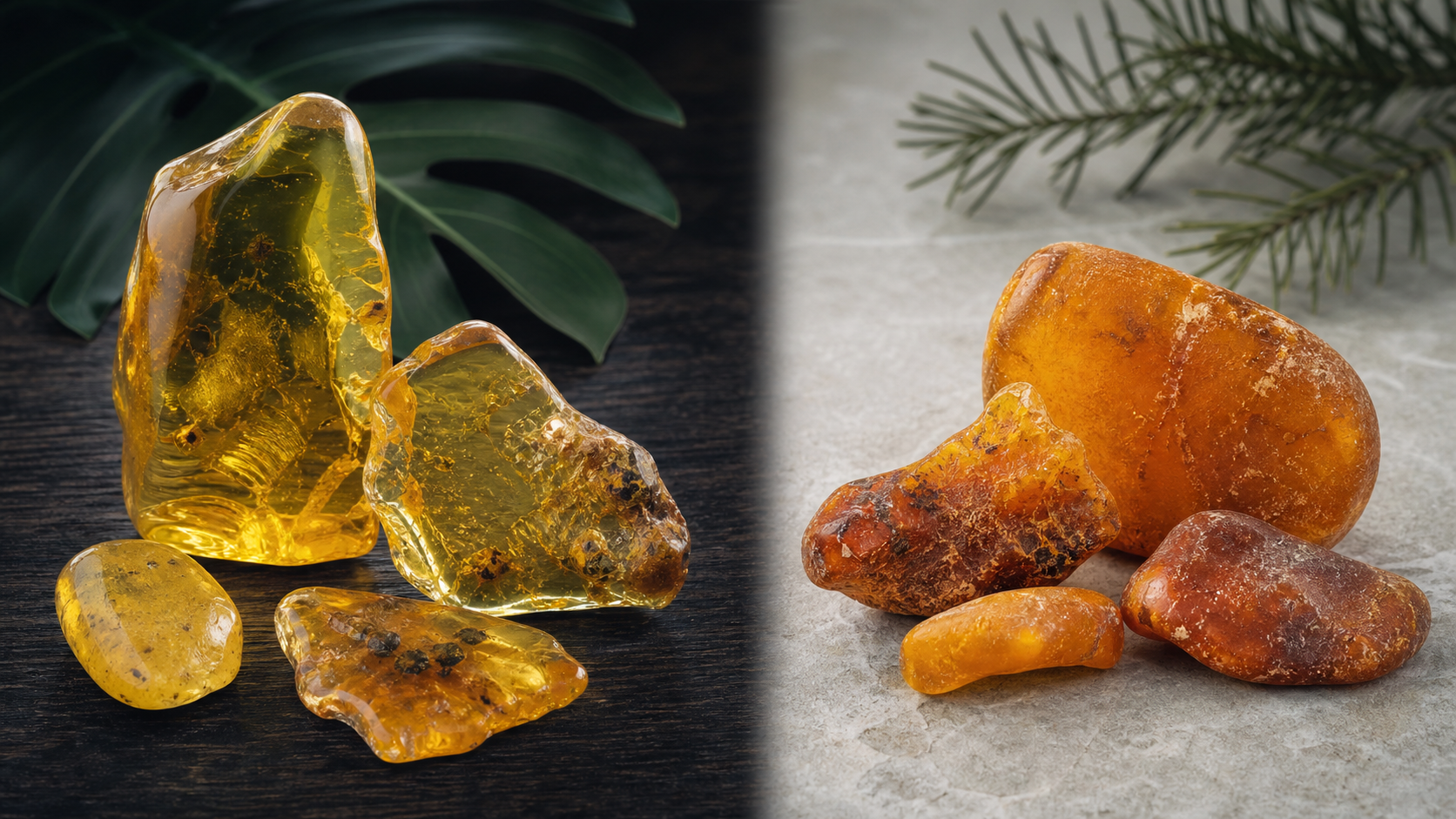
Original editorial illustration created for this guide. It is not a laboratory specimen, archaeological photograph or reconstruction.
Different deposits and ecosystems
“Amber” describes fossilized plant resin, not one uniform substance. Dominican and Baltic amber formed in different places, times and forest ecosystems. Their preserved organisms therefore represent different biological communities and climates.
Age
Scientific reviews commonly place major Dominican amber deposits in the Miocene, often around 15–20 million years old depending on the locality and interpretation. Baltic amber is substantially older, commonly associated with the Eocene and often summarized near 40–45 million years. A seller should avoid assigning an exact age to an individual piece without deposit information.
Botanical and chemical differences
Dominican amber is strongly associated with the extinct legume tree Hymenaea protera. Much Baltic amber is succinite, named for its succinic-acid component, but the precise botanical source of the vast Baltic amber forest has been debated. Chemical tests and spectroscopy are more reliable than color alone.
Appearance and fluorescence
Dominican amber is often prized for clarity, varied honey colors and strong blue or greenish-blue fluorescence in certain specimens. Baltic amber occurs in transparent through cloudy forms and is famous for yellow, golden and cognac material. Neither origin is limited to one appearance, and treatments can alter color and clarity.
Fossil inclusions
Both deposits preserve scientifically important organisms. Dominican inclusions represent a younger tropical Caribbean ecosystem; Baltic inclusions represent an older Eocene forest assemblage. Inclusion abundance varies by piece, and clarity can influence how easily fossils are observed.
Can origin be identified visually?
Sometimes appearance suggests an origin, but visual inspection is not definitive. Refractive index, density, fluorescence, infrared spectroscopy and other laboratory methods may help. Provenance and a trustworthy seller remain important, especially for valuable blue-fluorescent material or exceptional fossils.
Sources and further reading
Explore exact-item pieces
Every available piece is individually photographed, so the item shown is the item you receive.
Shop related piecesMore journal articles